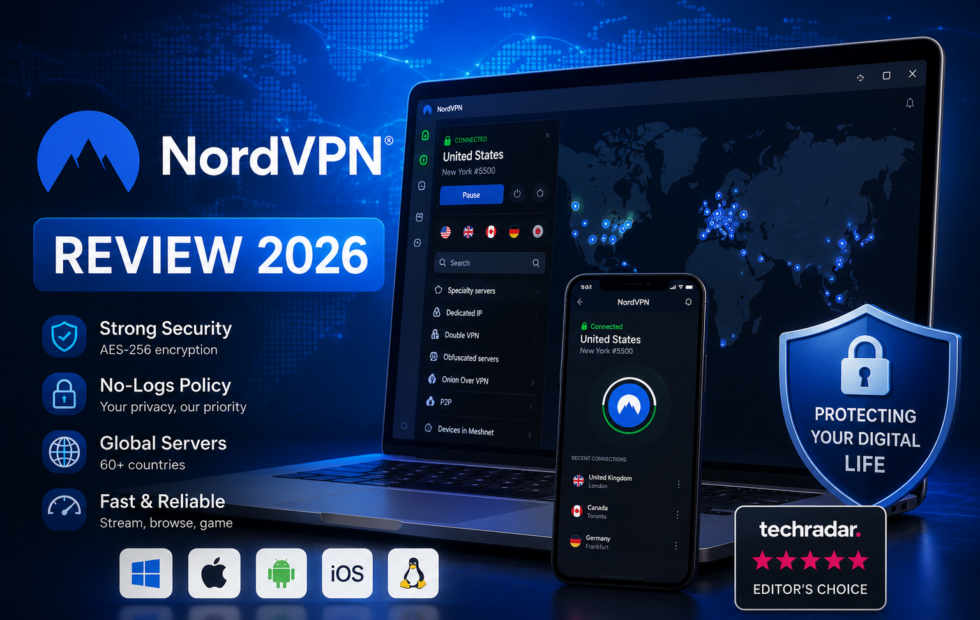
NordVPN is the fastest and is one of the best, if not the best, VPNs I’ve tested this year, and whether it’s worth buying comes down to a number it doesn’t advertise. Across 11 server locations, my nearest server came back faster than my no-VPN connection, every streaming platform I tried unblocked on the first attempt, and the no-logs policy has now survived six external audits and one real court order. The advertised price is $3.49 a month. The renewal is $139.08 a year, or $11.59 a month. Averaged across a two-year term plus one renewal, NordVPN actually costs $5.98 a month, and it’s still worth it at that price.
I also timed a torrent download, forced the kill switch to fire mid-transfer, and requested a refund to check the 30-day guarantee. Then I went back through Nord’s own pages, because the plan structure changed this year and most published reviews are describing a product Nord no longer sells.
Who should buy it, and who shouldn’t
Buy NordVPN if you want a no-logs claim that’s been checked by an outside firm six times, a network that reaches places most providers skip, and extras like Meshnet that you’ll actually switch on. It’s also the right pick if you want one subscription covering ten devices and you’re willing to set a calendar reminder to reprice in two years.
Skip it if you need port forwarding for seeding, since Nord doesn’t offer it and Private Internet Access does. Skip it if you’re travelling to China and need something that reliably connects, because Nord’s own support won’t promise that. And skip it if you want the lowest three-year cost, because Surfshark’s renewal sits lower and it covers unlimited devices instead of ten.
Pros and cons
Speed holds up where it matters. My nearest server returned 176.10 Mbps against a 169.74 Mbps baseline. Even Singapore, on the other side of the planet, held 136.80 Mbps.
Six no-logs assurance engagements. The most recent ran November 10 to December 12, 2025, under ISAE 3000 (Revised), with Deloitte Lithuania inspecting standard, Double VPN, obfuscated, and Onion Over VPN servers.
Panama jurisdiction with a documented test. In October 2024 a Panamanian prosecutor served a binding warrant. Nord handed over payment data and confirmation that an account existed. Nothing else, because nothing else was there.
Unblocked every streaming platform I tried, including 15+ Netflix libraries.
Genuinely wide coverage. 55 US cities, plus servers in Nigeria, Mongolia, Andorra, and Papua New Guinea. Most providers stop at the profitable markets.
Ten simultaneous devices, and a router install counts as one.
Renewal roughly triples the monthly rate. Basic goes from $3.49 to $11.59. Complete goes from $4.49 to $18.29, a 4x jump.
Connecting to distant servers is slow. Australian servers took up to 45 seconds, and twice I force-quit the app before a connection succeeded.
No port forwarding. If you seed, this costs you peers.
Split tunneling is Windows and Android only. macOS and iOS users don’t get it.
Upload speeds collapse over distance. Australia returned 11.52 Mbps against a 66.65 Mbps baseline, an 83% drop.
Scorecard
| Factor | Weight | Score |
|---|---|---|
| Speed | 20% | 9.2 |
| Renewal pricing and transparency | 20% | 6.0 |
| Privacy and audit record | 20% | 8.5 |
| Security features | 15% | 8.5 |
| Streaming | 10% | 9.5 |
| Apps and platform parity | 10% | 6.5 |
| Support | 5% | 7.5 |
Weighted total: 8.0 / 10
How I tested. Speed tests ran from a fixed US location on a wired connection, using NordLynx, with a no-VPN baseline captured immediately before the run. Streaming checks used a clean browser profile with cookies cleared between platforms. The kill switch test involved dropping the network adapter mid-transfer and watching the reconnect window, which is where kill switches usually fail. I bought a subscription at retail and requested a refund through live chat rather than testing on a comped account. Pricing, server counts, protocol availability, and audit dates were verified against NordVPN’s own pages in July 2026.
What NordVPN actually costs
Nord restructured its plans, and most reviews haven’t caught up. There are three tiers now, not four. The Plus tier that competing reviews still describe no longer appears on Nord’s pricing page. What’s left is Basic, Complete, and Prime.
Here’s the two-year pricing as of July 2026. Each two-year plan includes three extra months, so you’re billed for 27 months up front.
| Tier | Intro monthly | Total, first 27 months | Annual renewal | Renewal per month |
|---|---|---|---|---|
| Basic | $3.49 | $94.23 | $139.08 | $11.59 |
| Complete | $4.49 | $121.23 | $219.48 | $18.29 |
| Prime | $7.49 | $202.23 | $296.28 | $24.69 |
One-year plans start at $4.49 for Basic ($53.88 up front), $5.49 for Complete, and $8.49 for Prime. They renew at exactly the same annual figures as the two-year plans. Monthly plans cost $14.99, $19.99, and $29.99, with no discount at all.
The three-year number nobody publishes
The intro price applies once. When your 27 months expire you’re renewing at the annual rate, and there’s no path back to $3.49 short of cancelling and creating a new account with a new email.
So the honest comparison isn’t $3.49 against a competitor’s headline. It’s what you pay across a realistic ownership window.
| Basic plan route | Months covered | Total cost | Effective monthly |
|---|---|---|---|
| 2-year plan, then one annual renewal | 39 | $233.31 | $5.98 |
| 1-year plan, then two annual renewals | 36 | $332.04 | $9.22 |
| Monthly, for comparison | 27 | $404.73 | $14.99 |
Take the two-year deal. That’s not close. But price it at $5.98, not $3.49, and decide whether it’s worth it at that number.
Nord’s own promotional footnote is unusually candid about how the discount gets calculated. The “75% off” figure compares the intro monthly price of the two-year top-tier plan against the current monthly price of its annual renewal. The company is measuring its discount against its own renewal price, which is precisely the thing the discount is hiding.
What each tier adds
Basic covers the VPN, ten devices, scam and phishing protection, and Dark Web Monitor for up to five email addresses.
Complete adds the anti-malware engine, advanced browsing protection, an ad and tracker blocker, unlimited email protection, the NordPass password manager, 1 TB of NordLocker storage, scam call protection, and Dark Web Monitor Pro, which extends monitoring to eight emails plus phone numbers, credit cards, and national ID numbers.
Prime layers on Coveron, Nord’s identity protection service, with one-bureau credit monitoring, a VantageScore 3.0 credit score from TransUnion, credit freeze assistance, $1 million in identity theft insurance, and $100,000 in cyber extortion coverage.
Two things sit outside the tiers entirely. A dedicated IP is a paid add-on at checkout on every plan, including Prime. So is Incogni, the data removal service. If you saw a bundle description that included either as standard, it’s out of date.
The tier split matters for one reason above all: the anti-malware and ad-blocking that Nord markets heavily is not in the Basic plan. If you buy the $3.49 option expecting the malware scanner from the ads, you’re buying the wrong tier. Complete is the cheapest plan that includes it, and its renewal is $219.48 a year.
The refund actually works
I requested a refund through live chat. The agent asked once why I was leaving, accepted the answer without pushing a retention offer, and processed it. The money landed back on my card in five days.
One exception worth knowing: if you subscribe through the Apple App Store, Google Play, or Amazon, refunds go through those stores rather than Nord. The 30-day guarantee doesn’t bind Apple.
To stop the renewal price from landing, log in to your Nord Account, open Billing, then Subscriptions, and cancel auto-renewal. That doesn’t end your current term. It stops the card charge when the term expires.
Payment methods include the major cards, PayPal, Google Pay, Apple Pay, UnionPay, GrabPay, Sofort, iDEAL, Twint, and a range of cryptocurrencies including Bitcoin, Ethereum, Litecoin, and stablecoins. You can also buy prepaid cards with cash at Best Buy and Target. Pair a prepaid card with a throwaway email and Nord holds almost nothing tied to your identity.
Speed
Baseline and results, all captured on the same line in the same session using NordLynx:
| Server | Download | Upload | Ping | Retention |
|---|---|---|---|---|
| No VPN | 169.74 Mbps | 66.65 Mbps | 8 ms | — |
| Dallas | 176.10 | 123.43 | 11 ms | 104% |
| Los Angeles | 146.40 | — | 32 ms | 86% |
| New York | 144.13 | 52.34 | 41 ms | 85% |
| Miami | 134.02 | 49.01 | 52 ms | 79% |
| Canada | 189.65 | 39.42 | 42 ms | 112% |
| Brazil | 129.27 | 15.31 | 186 ms | 76% |
| UK | 121.61 | 20.03 | 110 ms | 72% |
| France | 129.47 | — | 116 ms | 76% |
| Japan | 161.50 | 57.07 | 151 ms | 95% |
| Singapore | 136.80 | 10.02 | 217 ms | 81% |
| Australia | 107.20 | 11.52 | 207 ms | 63% |
Two servers beat my no-VPN baseline. Dallas returned 176.10 Mbps and Canada returned 189.65 Mbps, both above 169.74. That isn’t a measurement error and it isn’t magic. A VPN tunnel can route around ISP congestion and around throttling applied to specific traffic types, and on a line in the 150 to 350 Mbps range that gain sometimes outweighs the encryption overhead. If you’re on gigabit fibre you won’t see this, because there’s no congestion to route around and the tunnel becomes pure overhead. Testers on 1 Gbps lines typically report retention closer to 73% to 90%.
Japan at 95% is the result that surprised me most. It’s roughly 6,500 miles away and it outperformed Miami. Server load and routing quality matter more than raw distance once you’re past the first few hundred miles, which is why picking the geographically nearest server isn’t always the right move. Try three and keep the fastest.
Upload is where distance genuinely hurts, and nobody reports this. Download to Australia held at 63% of baseline. Upload fell to 11.52 Mbps from 66.65, an 83% drop. Singapore was worse in proportion at 10.02 Mbps. If you back up to cloud storage, upload video, or run video calls through a long-distance server, the download figures every review quotes will not describe your experience. Brazil showed the same pattern at 15.31 Mbps up against 129.27 down.
Ping stayed under 52 ms across North America, which covers competitive gaming. Everything transatlantic sat between 110 and 116 ms, playable for casual sessions and not for anything twitch-based. Asia-Pacific ran 151 to 217 ms, which is fine for streaming and unusable for shooters.
What NordLynx actually does
NordLynx runs WireGuard’s cryptography, then adds a double network address translation layer on top. WireGuard on its own has a known privacy wrinkle: it needs a static IP address assigned to each connected user, stored on the server. The double NAT setup matches your session to a temporary address instead, so no static user IP sits on disk. That’s the whole trick, and it’s a real one.
Nord offers three other protocols. OpenVPN in UDP and TCP flavours, slower and older and still the thing to reach for when a network filters aggressively. NordWhisper, built for restrictive networks like campus and office firewalls that block ordinary VPN traffic. And IKEv2/IPSec, now manual-configuration only rather than an in-app choice.
Nord’s “fastest VPN” claim traces to West Coast Labs testing from October 2025. The full report is published, which is more than most speed claims manage. It’s also a single point in time from a lab the company commissioned and pays.
Connection time is the real weakness
Throughput was strong everywhere. Getting connected was not. Nearby servers linked in two to three seconds. Australian servers took up to 45 seconds, and on two occasions I force-quit and relaunched the app before a connection went through. Japan and Singapore were slow but consistent, around 15 seconds.
This won’t show up in any speed table, and it’s the thing you’d actually notice day to day.
Streaming
| Platform | Result | Servers tried |
|---|---|---|
| Netflix US | Unblocked | 1 |
| Netflix UK | Unblocked | 1 |
| Netflix Japan | Unblocked | 1 |
| Netflix Argentina | Unblocked | 2 |
| Netflix Malaysia | Unblocked | 1 |
| Netflix Thailand | Unblocked | 1 |
| BBC iPlayer | Unblocked | 1 |
| Disney+ | Unblocked | 1 |
| Hulu | Unblocked | 1 |
| Amazon Prime Video | Unblocked | 1 |
| Max | Unblocked | 1 |
| ESPN+ | Unblocked | 1 |
| DAZN | Unblocked | 1 |
| Sling TV | Unblocked | 1 |
The server count column matters. “Works with Netflix” means nothing without a denominator, and a VPN that loads a library on the first attempt is a different product from one that loads it on the fourth. Only Argentina needed a second server.
More than 15 Netflix libraries loaded in total, and everything streamed in 4K without buffering. Nord’s SmartPlay handles DNS routing automatically, so there’s no configuration step.
There’s a caveat that changes how much help you can expect when something breaks. Nord no longer lists streaming platform support on its own website. The service still works, but the company has stopped advertising compatibility, which means when a server stops working with a given platform, support has no official position to fall back on and no obligation to fix it. You troubleshoot alone. CyberGhost, by contrast, labels individual servers by platform and maintains them.
Nord also has no dedicated streaming servers. Any server may work, which is simpler when it works and frustrating when it doesn’t, because there’s no shortlist to try next.
Security features
Nord uses AES-256-GCM with SHA-512 for authentication, plus perfect forward secrecy, which rotates the session key so a single compromised key can’t decrypt earlier or later traffic. Post-quantum encryption is available on NordLynx. That’s the cipher discussion. It differentiates nothing, because every provider at this price uses comparable cryptography.
What differentiates is whether the features hold when something goes wrong.
Kill switch and leaks
Nord ships two kill switches. The Internet Kill Switch blocks all traffic when the tunnel drops. The App Kill Switch closes specific programs instead, which is the better setting if you want your torrent client killed but your browser left alone.
I dropped the network adapter during an active transfer and watched the reconnect window, since a switch that blocks traffic after a two-second gap has already leaked for two seconds. Nothing escaped. I also switched between distant servers mid-session, from Germany to Australia, and saw no address exposure during the handover.
DNS and WebRTC checks came back clean across every server I tested. Nord runs its own DNS resolvers, so lookups stay inside the tunnel rather than passing to your ISP’s resolver.
Threat Protection
The naming is confusing and the confusion costs money. Basic includes what Nord calls scam and phishing protection. The full anti-malware engine, download scanning, ad and tracker blocking, and advanced browsing protection all sit in Complete and Prime.
On ad-heavy news sites it stripped most display advertising and blocked tracker requests, though it let some sponsored inline content through. It’s a competent browser-level blocker. It isn’t a replacement for a dedicated ad blocker extension, and running both is fine.
Meshnet
Meshnet links your devices over encrypted connections without routing through a VPN server. You can connect up to 10 of your own devices and 50 belonging to other people. It handles remote desktop access, file transfers between machines on different networks, and LAN-only games played across cities. It’s free, including on Basic, and it’s the extra most worth having.
Specialty servers
Double VPN routes traffic through two servers, encrypting twice. It costs roughly half your speed and defends against a threat model most people don’t have.
Onion over VPN pushes traffic through Nord’s tunnel and into the Tor network without the Tor browser. Your ISP sees a VPN connection rather than Tor traffic.
Obfuscated servers disguise VPN packets as ordinary HTTPS so deep packet inspection doesn’t flag them.
P2P servers carry torrent traffic and are the only ones that should.
Split tunneling
Available on Windows and Android. Not on macOS or iOS. If you need certain apps outside the tunnel on a Mac, Nord can’t do it.
Privacy: what “no logs” covers, and what it doesn’t
The audit record
Nord has completed six independent no-logs assurance engagements: 2018, 2020, 2022, 2023, 2024, and the most recent at the end of 2025.
The sixth ran under ISAE 3000 (Revised), conducted by Deloitte Lithuania. Practitioners had access to Nord’s systems from November 10 to December 12, 2025, interviewed staff, and inspected server infrastructure, configurations, and deployment processes across standard VPN, Double VPN, obfuscated, and Onion Over VPN servers. The final report was issued December 12, 2025. Deloitte concluded that Nord’s systems are designed and implemented in line with its no-logs statement.
Two caveats Nord states plainly and most reviews drop.
First, it’s a point-in-time assessment. Deloitte examined the systems as they ran during that 33-day window. It says nothing about the configuration in March, or now.
Second, the report isn’t published. Nord cites its technical nature and makes it available only after you log in to a Nord Account. You can read it, but you have to be a customer to do so, and you can’t link it to anyone else. That’s a meaningful step below full publication.
One more oddity: the FAQ on Nord’s own server page still says the no-logs policy has been “audited and approved four times,” and puts the network at 9,431 servers across 149 countries, while the headline on the same page says 224 locations. The audit count is two engagements out of date. Small thing, but when a company’s own marketing pages disagree with each other, treat every unsourced number on them as approximate.
The 2018 server breach
In March 2018, an attacker reached a NordVPN server in a Finnish data center by exploiting an insecure remote management system the data center provider had left in place. Nord didn’t own the hardware and didn’t know the interface existed. One rented server was affected. Nord says no user credentials were exposed.
The uncomfortable part is the timeline. Nord disclosed the incident publicly in October 2019, roughly 18 months after it happened, and did so after the breach surfaced on Twitter rather than before.
What changed afterward is concrete and checkable. Nord moved to RAM-only servers, which hold everything in volatile memory and wipe on reboot, so there’s no disk to seize. It began colocating hardware it controls instead of renting whole servers. And it moved from occasional audits to annual ones, which is how the count reached six.
Whether that’s enough is your call. My read: the incident was a vendor failure, the disclosure delay was Nord’s failure, and the remediation was real.
The October 2024 warrant
This is the closest thing to proof that exists.
In October 2024, in connection with a criminal investigation, Nord received a binding warrant from the Panamanian prosecutor’s office. The warrant was properly issued under Panamanian law, so Nord was legally required to hand over the user data in its possession.
What it handed over: payment-related data, and confirmation that an account existed tied to an email address the authorities already had. That was everything it had. No traffic logs, no connection logs, no browsing activity, because none of it is stored.
Nord disclosed this itself, in the same announcement where it retired its warrant canary in favour of transparency reports. The canary worked by omission, which meant users had to notice something missing and infer what it meant. The reports instead publish counts of government inquiries and DMCA requests on a rolling basis. For the quarter ending March 31, 2026, Nord logged 2,516,141 automated DMCA requests and 84 government enquiries, with the number of orders that produced any user information still standing at one.
The disclosure cuts both ways, and that’s what makes it useful. Nord complied. It didn’t fight the warrant into the ground or refuse. It handed over the little it had, and the little it had turned out to be genuinely little. That’s a better test of a no-logs policy than any audit, because nobody chose the conditions.
What the policy still leaves exposed
Your billing details and account email exist. So does the fact that an account exists. If your threat model includes someone learning that you are a NordVPN customer, a no-logs policy doesn’t help, and you should be paying with a prepaid card and a throwaway address.
A VPN also does nothing about cookies, browser fingerprinting, or any service you’re logged into. Nord hides your IP from the sites you visit and hides your destinations from your ISP. Everything else about tracking stays exactly as it was.
Jurisdiction
NordVPN operates under Panamanian jurisdiction. Panama has no mandatory data retention law and sits outside the Five, Nine, and 14 Eyes arrangements. Nord responds to Panamanian court orders; foreign requests have to route through Panamanian legal process to have force.
Parent company Nord Security is based in the Netherlands, a Nine Eyes member. Nord Security also merged with Surfshark’s holding company in 2022, though the two VPNs run as separate services with separate infrastructure.
Servers and network
Nord’s site currently claims coverage across 224 locations, and its own FAQ puts the figure at 9,431 servers in 149 countries. Take the country count as reliable and the server count as approximate.
US coverage is the standout: 55 cities, from Albuquerque and Anchorage to Wichita and Wilmington. Canada gets four cities, the UK four, France four, Australia five, Germany three, Italy three, Japan two. Beyond the obvious markets there are servers in Bhutan, Mongolia, Papua New Guinea, Greenland, Andorra, Monaco, and the Isle of Man. There are none in China or Russia.
Nord owns and operates almost all of its hardware and colocates rather than renting whole servers, which is the direct consequence of 2018. Every server runs from RAM. Some locations are virtual, meaning the IP address belongs to one country while the physical machine sits elsewhere, and Nord marks these in the server list rather than hiding them. My ping figures tracked genuine physical distance across every location I tested, which is consistent with real hardware rather than spoofed geography.
A dedicated IP costs extra at checkout and is available in a set of US and international cities. Worth it if CAPTCHAs interrupt your work or your bank keeps flagging logins from rotating IPs. It’s a downgrade for privacy, because an address used only by you is an address that identifies you.
Does NordVPN work in China?
Sometimes. Not dependably.
Nord’s own support won’t guarantee a connection. Obfuscated servers and the NordWhisper protocol both exist for exactly this problem, and both work some of the time, with the Great Firewall’s blocking behaviour changing without notice.
If you’re going anyway: install the app before you travel, since Nord’s website and the app stores are blocked inside the country. Ask support for the current recommended server list before departure, because it changes. Expect outages regardless.
The same caveat covers Iran, Russia, and the UAE. Using a non-approved VPN in China is against local regulations, though there’s no public record of tourists being prosecuted for it. Check the law wherever you’re going.
Torrenting
Nord supports P2P on dedicated servers across a large share of its network, reachable from the Specialty Servers menu. When I started a torrent client while connected to a regular server, Nord moved me to a P2P server automatically rather than blocking the traffic.
I downloaded a 1.16 GB public-domain film in under three minutes, which is close to what the same file took without a VPN. Seeding worked without configuration.
The kill switch, leak protection, and Panamanian jurisdiction cover the basics for P2P privacy.
Port forwarding isn’t available, and won’t be. Port forwarding lets peers connect to you directly instead of only outbound, which raises your seed ratio and often your download speed. It also opens a port on a machine sharing an IP with other VPN users, which is why security-focused providers keep declining to offer it. If it matters to you, Private Internet Access supports it. That’s a legitimate reason to pick a different VPN, and it isn’t a flaw in Nord.
Torrenting is legal in most places. Downloading copyrighted material generally isn’t. Stick to public domain and legally distributed files.
Apps and setup
| Platform | Support |
|---|---|
| Windows | 7 and newer |
| macOS | Native Apple Silicon build |
| Linux | Command line only (Debian, Ubuntu, Mint, Fedora, RPM distributions) |
| Android | Yes, plus 7-day Google Play trial |
| iOS | Yes |
| Browser extensions | Chrome, Firefox, Edge |
| Smart TV | Android TV, Apple TV, Fire TV |
| Consoles | Smart DNS only, no encryption |
| Routers | Manual setup, plus a Lite package for OpenWrt |
Install took under three minutes on Windows and about the same on macOS. Login runs through the browser and hands back to the app.
Feature parity is uneven, and the differences aren’t documented anywhere obvious:
Windows gets everything, including split tunneling and custom DNS.
macOS ships in two versions that are not the same product. The App Store build carries a reduced Threat Protection. The version downloaded from Nord’s site carries the full one. Neither has split tunneling.
Android includes split tunneling and per-network auto-connect.
iOS has auto-connect but no split tunneling, which is an Apple platform constraint rather than a Nord decision.
Linux is command line with no graphical interface.
Apple TV runs a real app using NordLynx with full encryption, which is unusual. Most providers hand TV users a Smart DNS setup that does no encryption at all.
Consoles get Smart DNS, which changes your apparent region and encrypts nothing. For actual protection on a PlayStation or Xbox, install on the router.
I ran six devices at once while streaming and downloading with no measurable slowdown. Ten connect simultaneously, and a router installation consumes one slot while covering everything behind it, which is the move for households above the limit.
Support
I contacted live chat four times. A chatbot answers first; typing a request for an agent moved me to a person in under a minute each time. You need only a name and email, and you can ask questions before you’re a customer.
I asked about renewal pricing specifically, because it’s the question agents most often get wrong. The first agent quoted me the new-customer rate for a two-year plan when I’d asked what an existing subscriber pays at renewal. Pressed on it, the agent corrected the answer and gave the right annual figure. That’s a small thing that costs people real money, and it’s worth confirming any renewal quote against your Nord Account billing page rather than taking chat’s word for it.
Technical questions went better. Questions on router configuration and specialty server selection got accurate answers without a scripted detour. Email replies came back within a business day.
The Help Center is strongest on router configuration and manual setup, where the guides include screenshots and match the current app.
Alternatives
Surfshark, if three-year cost drives the decision. Unlimited simultaneous devices instead of ten, and a renewal price meaningfully below Nord’s. The trade is jurisdiction, since Surfshark is Dutch and the Netherlands sits inside Nine Eyes, and a torrenting interface that doesn’t label P2P servers clearly.
Private Internet Access, if you seed. It supports port forwarding and a SOCKS5 proxy, allows unlimited devices, and runs a far larger raw server count. Its apps expect you to know what you’re adjusting.
ExpressVPN, if you want the fewest interruptions and will pay for it. Every server takes P2P traffic, obfuscation runs automatically without a specialty menu, and the no-logs policy survived an actual server seizure in Turkey in 2017. Fewer configurable settings, and a higher price.
The bottom line
NordVPN does almost everything competently and two things unusually well: it publishes what happened when a prosecutor came asking, and it maintains a network that reaches countries most providers ignore. In testing it was fast enough that my own line was the limiting factor on nearby servers, and it unblocked every streaming platform I pointed it at.
The failure mode is the bill. The intro price is real, it’s genuinely good value across the first 27 months, and it converts into $139.08 a year without asking. Buy the two-year plan, buy Complete rather than Basic if you want the malware blocking Nord advertises, cancel auto-renewal the day you subscribe, and put a reminder in your calendar for month 26.
FAQs
Is NordVPN worth it in 2026?
At $5.98 a month averaged across a two-year term plus one renewal, yes, if you want audited privacy and a wide network. At the advertised $3.49, the question doesn’t mean anything, because nobody pays $3.49 for longer than 27 months.
Does NordVPN have a free trial?
Seven days on Android, through Google Play only, one per customer. There’s no trial for web purchases. The 30-day money-back guarantee is the practical substitute, and it covers your first purchase rather than renewals.
Will NordVPN slow my connection?
On my 169.74 Mbps line, two servers came back faster than no VPN at all and the nearest US server held 104% of baseline. Distant servers cost more: Australia returned 63% of download and 17% of upload. Gigabit users should expect losses of 10% to 27% even on nearby servers.
Can I be tracked while using NordVPN?
Yes, through methods a VPN doesn’t touch. Cookies, browser fingerprinting, and any account you sign into all identify you regardless of your IP address. Nord hides your address from sites and your destinations from your ISP. That’s the boundary.
Is NordVPN trustworthy?
The evidence: six no-logs assurance engagements, Panamanian jurisdiction, published transparency reports, and one real warrant in October 2024 where it produced payment data and nothing else. Against that: a 2018 breach disclosed 18 months late, and an audit report you can only read from inside a paid account.
Is NordVPN better than ExpressVPN?
Nord costs less at renewal, covers more countries, and includes more built-in tools. ExpressVPN allows torrenting on every server, obfuscates automatically, and has had its no-logs claim tested by a server seizure. If you want fewer decisions, ExpressVPN. If you want more capability per dollar, Nord.
How do I stop the price increase?
Log in to your Nord Account, open Billing, then Subscriptions, and cancel auto-renewal. Do it now rather than later; the current term runs to its end either way.
Does NordVPN work with Kodi?
Yes. Connect the VPN on the device before opening Kodi, with no add-on required. On hardware that can’t run the app, install on the router.